
A student raises their hand for help on an essay. Instead of waiting for the teacher, they open Flint AI. Within seconds, the chatbot generates feedback, suggests revisions, and explains how to improve the paper. Convenient? Absolutely. But as artificial intelligence rapidly enters classrooms across the country, including ours, many students and teachers are beginning to ask a more difficult question: Are schools moving too fast?
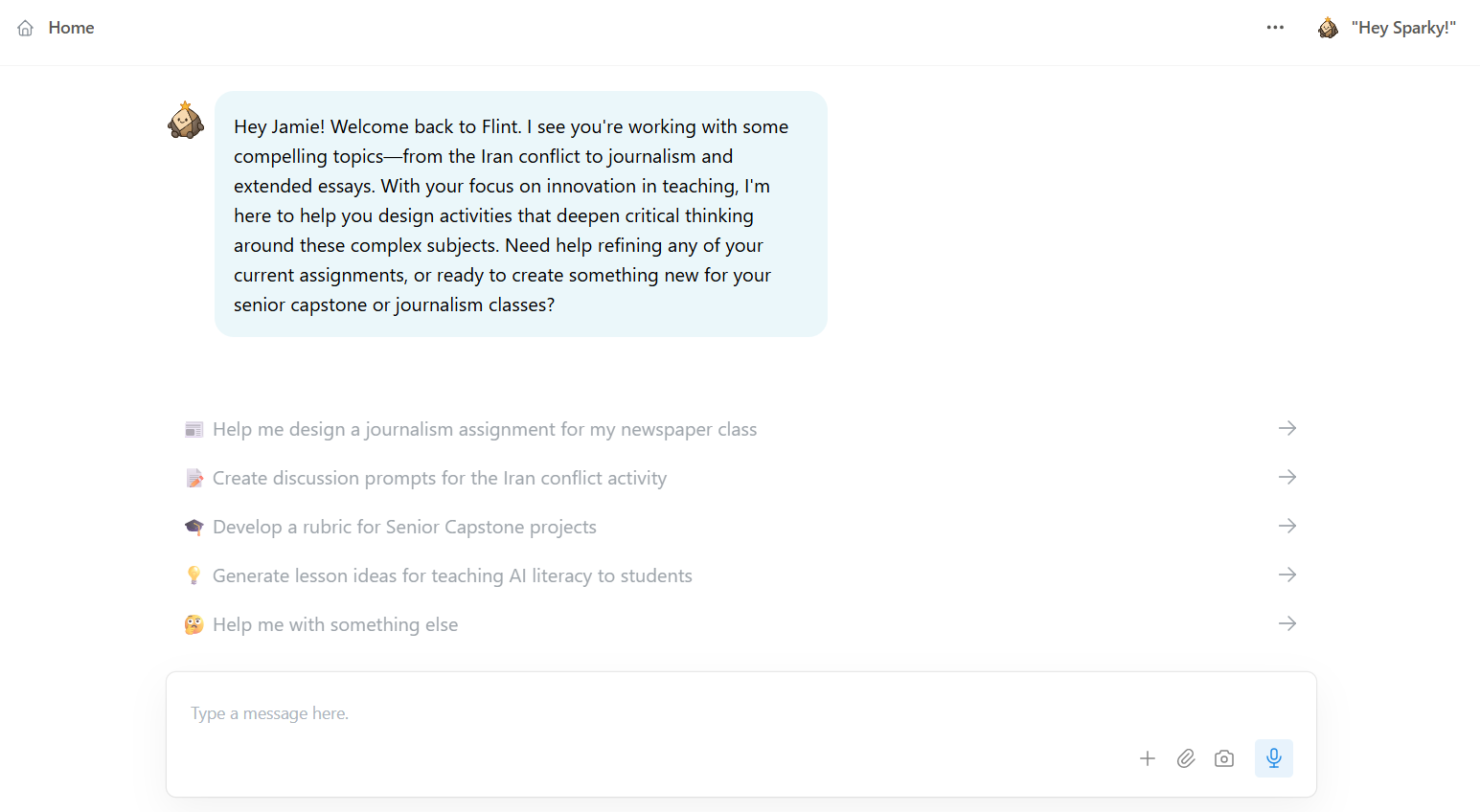
This year our school incorporated Flint AI into the curriculum, joining a growing trend in education focused on AI-assisted learning. Flint AI is marketed as an education-specific platform that allows teachers to create AI tutors, classroom discussions, and personalized assignments. Supporters argue that it saves teachers time and gives students academic support. But critics say the technology may create more problems than it solves.
The rise of AI in schools has been dramatic. Across the United States, educators are increasingly adopting AI-powered tools to assist with writing, tutoring, and classroom management. Flint itself has reported heavy usage in partner schools. At Brophy College Preparatory, students logged nearly 11,000 AI tutoring sessions in only three months after the platform was introduced. Another school, McDonogh School, reported more than 4,500 sessions across grade levels. These statistics show how quickly students are turning to AI for help, but also raises concerns about dependence on technology for basic academic tasks.
Not only are there issues with students, but also Flint itself. The journalism team ran a test of our own. We each wrote a news summary on an article and asked both ChatGPT as well as Flint to give us suggestions on how we could improve our short news summaries. When Flint gave me its corrections, I tweaked my writing and again it gave me a long list of vague corrections that were rather unhelpful. To fact check me, Flint sourced information from websites that seemed to be unreliable such as: Scoop News and Wikipedia. To experiment, I asked ChatGPT to write me a short news summary and copied and pasted it into Flint and it did not detect that it was 100% AI generated. This could potentially allow students to freely use AI on Flint assignments and the bot nor their teachers would ever know.
Another big criticism of Flint AI and similar platforms is that they may weaken critical thinking skills. Education has traditionally depended on struggle and problem-solving. Students learn by working through difficult concepts, making mistakes, and asking questions. AI can shorten that process dramatically. Instead of wrestling with an idea, students may become accustomed to receiving immediate answers or guided responses. Over time, some educators worry this could reduce independent thinking and creativity.
Privacy concerns add another layer to the debate. AI systems depend on large amounts of user data to function effectively. Even if platforms claim to be secure, many parents and educators remain uneasy about students interacting daily with AI systems that collect information about conversations, assignments, and learning habits. Questions about where this data goes, and who ultimately controls it, remain largely unanswered.
Critics also argue that AI cannot replace the human side of education. A teacher does far more than explain information. Teachers motivate students, recognize emotional struggles, encourage participation, and adapt lessons based on classroom dynamics. AI may simulate conversation, but it cannot fully understand frustration, confidence, or curiosity in the same way a human teacher can. Some researchers warn that schools risk treating education as a technical problem instead of a human experience.
Even supporters of Flint AI acknowledge that there are risks if the technology is overused. AI can be helpful for brainstorming, tutoring, or reviewing concepts, but many educators believe it should remain a supplement, not a replacement, for traditional learning methods. The challenge for schools will be finding a balance between embracing innovation and protecting the skills students still need to develop on their own.
Our school’s decision to adopt Flint AI reflects a much larger shift happening in education nationwide. Artificial intelligence is becoming part of everyday learning whether schools fully embrace it or not. However, just because technology is available does not automatically mean it improves education. As students and teachers continue experimenting with AI in the classroom, the most important discussion may not be what AI can do, but what students could lose if schools become too dependent on it.