At one point, the Atlantic Ocean was an impassable boundary. Today, we can cross it in mere hours, surrounded by the comforts of home – television, food, and air conditioning. We walk off a plane into a city we once could not imagine reaching in a lifetime, and yet our minds have moved even faster than our bodies. In less than a second, a message can leave an investor in London and arrive in a boardroom in Boston, changing decisions, markets, and even people’s lives before anyone on either side has had time to breathe. That – the physical shrinking of distance beside the even greater collapsing of delay – is the focus of my article.
The concept explained – time-space compression – is often explained rather simply. Over time, technological advancement decreased our human perception of the distance between points in the world – but that does not tell the whole story. Maps shrink, yes, but the true transformation is subtler: it is the slow and for many unnoticeable erosion of delay. Months of sailing become weeks, weeks become days, days become hours, and finally hours become instantaneous. Each reduction did not only make travel cheaper or faster – it reimagined how people thought about schedules, obligations, and the scale of consequence. People began to plan as if the world were smaller, because messages, goods, and orders began to arrive sooner than anyone had expected.
Yet, for nearly 200,000 years, a thought could travel no faster than the human who carried it. Speech and gesture, word of mouth and foot, tied ideas to body, and that tether shaped our loyalties and the tempo of life. The invention of writing separated ideas from bodies- suddenly a thought could exist without the thinker – but it remained chained to the same slow cargo – this time as mail. A letter still needed a rider, a coach, or a ship. Finally, our knowledge could outlive its creator, but it did not yet outrun him. Until, that is, we began to find ways to make thought move on its own.
Across many millennia, from the Roman Empire to the modern day, information began to move at speeds once thought impossible. A Roman galley might reach four or five knots; such speeds were respectable in a world of oars and where human endurance was the true challenge in conquering the high seas. However, by the Napoleonic era, a frigate could achieve fourteen knots – this was already tripling practical cruising speed and had taken more than a thousand years to develop. Yet within two hundred years of that point the modern frigate now achieves thirty knots – in a time one-fifth as long, speed increased by almost twice as much. Those numbers mark an impressive acceleration. Each improvement shortened not only voyages but decision cycles: wars planned with weeks of delay gave way to conflicts fought with near-instant directives.
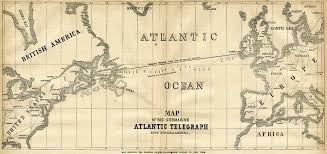
Then came the cable. For the first time, thoughts could not only travel separately from our bodies, but outrun them. The submarine telegraph did something different from any sail or mast: it removed geography from the equation of urgency. Whereas before news and orders accumulated like a backlog, the cable turned information into a stream. The implications were immediate and profound. Nations could coordinate across oceans; markets could react as if they were a single organism; commanders and ministers could be informed -for better or worse – in a manner that altered the logic of command.
The consequences were radical. Faster communication gave rise to corporate America in a new form – companies could manage far-flung operations and coordinate investment across continents. Empires could govern distant possessions with a firmer hand because they could receive reports and issue instructions within days instead of months. And the collapse of delay fed into the engine of modern war. The ability to communicate within hours changed strategy and politics, and it played a material role in conflicts like the Crimean War. During that war a cable between London and Bucharest was extended to link the Black Sea, while the British laid another line from Varna to the Crimean Peninsula. For the first time commanders and ministers could receive reports from battlefields in near real time, and those faster reports reshaped policy and perception in capitals.
Compare that to the age of sail and the Battle of Trafalgar. After that decisive engagement, John Richards Lapenotière took approximately two weeks to deliver his dispatches to William Marsden. Two weeks is not a long time today, but in an era when decisions depended on that courier, two weeks could mean misjudgment, missed opportunity, and the misallocation of resources. That latency spurred an industry of inventors and tinkerers — men and women who believed the world could be made more immediate.
Many great minds turned to this problem of delay. Guglielmo Marconi harnessed the air itself to carry messages without wires. The Wright brothers sought to make distance a matter of hours rather than months by conquering powered flight. Innovators like Frederick Gisborne experimented with cables and transmission techniques that would knit continents together. And centuries later, Tim Berners-Lee gave us an architecture that made knowledge instantly addressable and shareable at global scale. Each of these efforts, in its own register, was an answer to the same problem: the human impatience with delay.
All of this matters because the speed at which we can move information changes how we imagine responsibility, risk, and authority. When messages took weeks to arrive, local actors exercised de facto sovereignty; when instructions could be issued at once, centralized hierarchies gained power. Faster communication also increases culture: myths of distance, of the unreachable sea, bend into stories of exploration and commerce. The world did not simply become smaller on a map; it became a place where the consequences of a statement made in one city could ripple through others before the speaker had time to reconsider.